
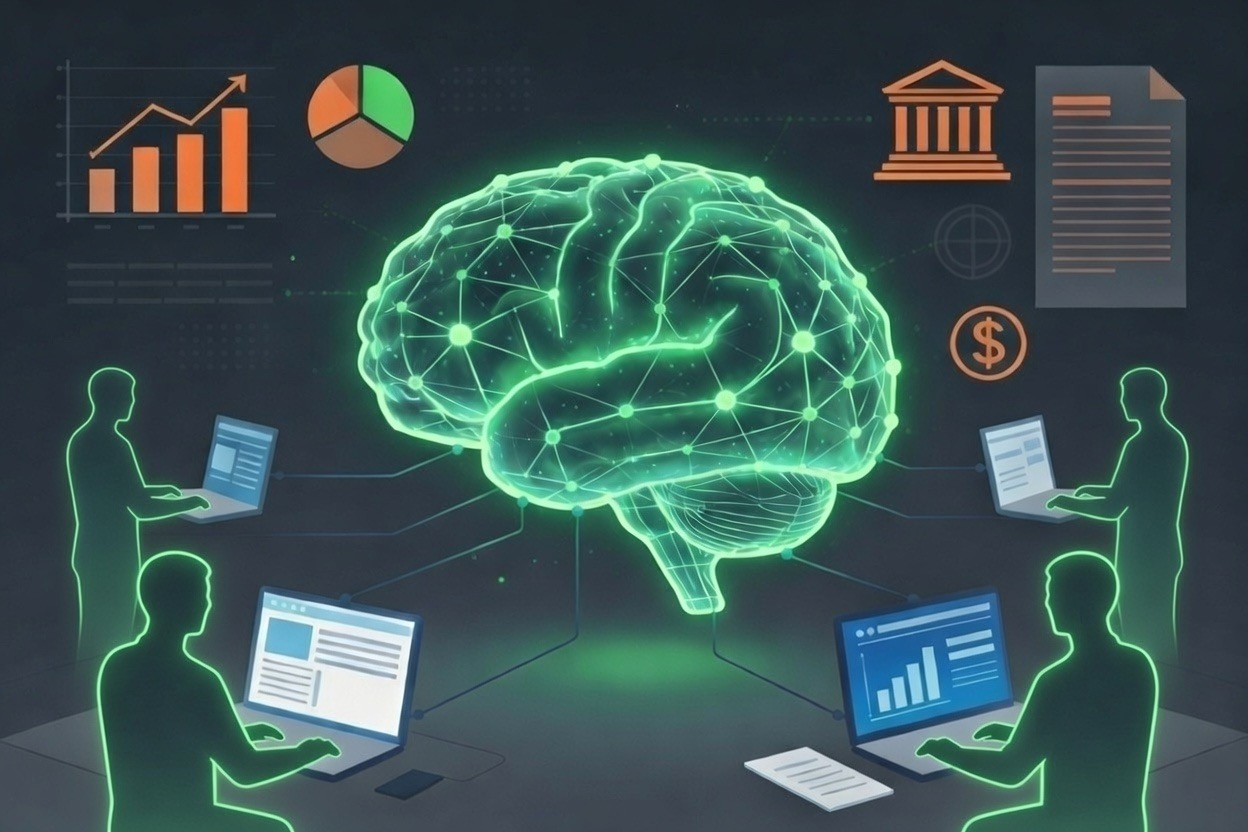
In the rapidly evolving landscape of enterprise AI, Agentic AI Architecture is emerging as the definitive next step beyond rule-based automation and traditional language models. This architectural shift focuses on agency: the ability of a system to act autonomously, plan, and interact with its environment, while still meeting the strict requirements of regulated environments such as banking.
The Problem of Embedded Logic
In many initiatives, business logic is baked directly into prompts or even into the fine tuning layer of the model. Every change to a policy, regulation, or Standard Operating Procedure (SOP) then forces manual updates across multiple prompts, including testing and approvals.
As the number of agents grows, this leads to prompt sprawl, identical rules exist in many slightly different versions, and maintenance becomes an operational risk. Agents are tightly coupled to their prompts, which slows down innovation and increases the risk of inconsistent behaviour across journeys and products.
From Prompt Logic to a Knowledge Layer
A more sustainable approach is to decouple the what (business logic) from the how (reasoning and execution). Instead of encoding process knowledge inside prompts, organisations define an external knowledge layer, a kind of digital twin for policies, Standard Operating Procedures (SOPs), and internal guidelines.
This creates a shared business brain that can be consumed by multiple generic agents. Specialisation happens at run time through context and retrieval, not through hard wired prompts, which means fewer agents are needed while reuse and consistency increase.
Maintainability as an Architectural Principle
When business logic lives in a central knowledge layer, maintenance starts to look more like configuration management than prompt tinkering. Key building blocks include:
- Versioned knowledge modules, rules and processes as machine readable, clearly scoped objects.
- Central governance, changes are made once in the repository and apply to all connected agents.
- Dynamic retrieval, agents always query the current state of relevant directives at run time.
Scaling is then driven by the quality of the knowledge architecture rather than by the number of specialised bots.
Lean Regression Testing for Agentic AI Architecture
Separating logic from reasoning also enables pragmatic regression testing for agentic systems. Instead of manually checking every prompt change, typical and critical scenarios can be replayed with stable inputs against the current knowledge base.
Expected results or tolerance bands are derived from existing decisions and policies and compared automatically with new agent responses, while lightweight validation agents flag deviations and make behaviour drift visible early.
MASS Where it still Matters
Google’s MASS (Multi Agent System Search) framework optimises multi agent systems by iteratively searching over prompts, roles, and topologies to improve system level performance on complex tasks. In an architecture with externalised logic, MASS remains useful where it tunes interaction and orchestration, for example how generic agents query the knowledge layer, combine results, and coordinate with each other. (arxiv - Multi-Agent Design: Optimizing Agents with Better Prompts and Topologies and MARKTECHPOST - Google AI Introduces Multi-Agent System Search MASS: A New AI Agent Optimization Framework for Better Prompts and Topologies)
The optimisation focuses on the collaboration patterns and dialogue structures between agents, while the actual rules and constraints are maintained in the knowledge infrastructure.
Digital Governance as Enabler
By digitalising governance and storing policies, guidelines, and regulatory requirements as structured, machine readable assets, organisations turn governance from a brake into an enabler. Agents can validate decisions against current rules, document their reasoning, and adapt automatically to new directives without touching prompts or model weights.
In banking and other regulated industries, this combination of autonomy, traceability, and rapid adaptability significantly increases acceptance from risk, compliance, and audit stakeholders.
Summary
This article shows how separating business logic from AI reasoning via a central knowledge layer makes agents more generic, maintainable, and testable. External, versioned rules and Standard Operating Procedures (SOPs) reduce agent sprawl and enable a shared business brain, supported by lean regression tests and targeted use of MASS to optimise how agents collaborate on top of that foundation. (MARKTECHPOST - Google AI Introduces Multi-Agent System Search MASS: A New AI Agent Optimization Framework for Better Prompts and Topologies)
Read also my previous related posts
- AI Efficiency in Banking: Opportunity, Fragility, and the Human Factor
- AI-Powered Compliance in Banking: Turning Complexity into Competitive Advantage
- Agentic AI: Advancements & Challenges in Communication & Optimization
- The AI Divide: Understanding Agents vs. Agentic Systems
- Unlocking the Future: Ways AI and Automation Solve Workforce Demographic Challenges