
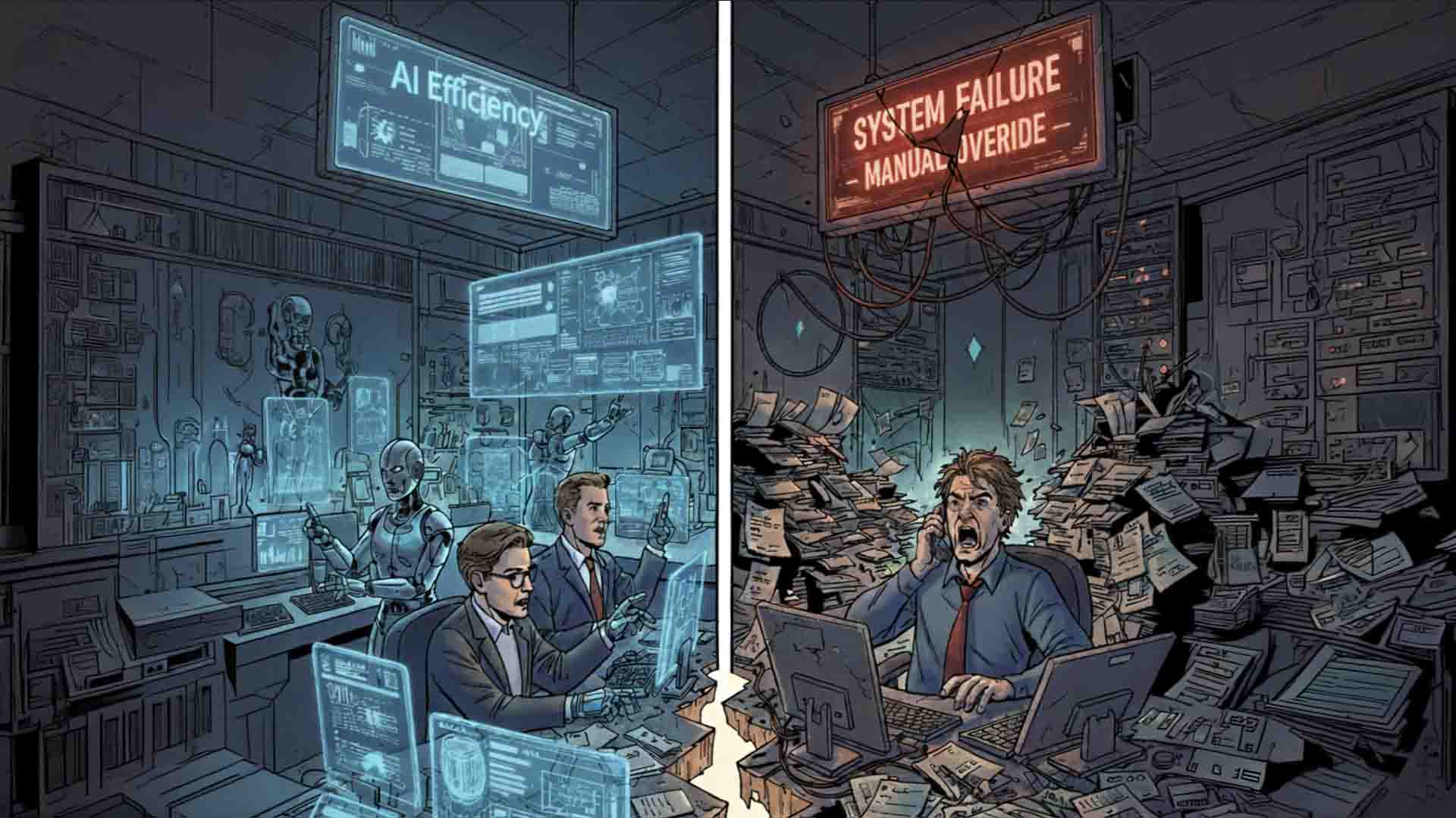
AI Efficiency in Banking has become the strategic answer to a fundamental paradox: while banks are knowledge-intensive service organisations, their human capital remains their greatest cost. In an environment shaped by margin pressure and digital competition, Swiss executive boards now view artificial intelligence as the essential leap in operational productivity to process more at lower costs.
Yet banks ultimately provide trust, not just transactions. The financial system’s value does not come from speed alone but from competence, continuity and judgement. When efficiency gains come from systems that learn patterns rather than meaning, the question becomes not «whether» AI can make banking more efficient, but «what kind» of efficiency banks can afford.
As this article will show, every gain in speed and scale comes at a cost, not only financial, but organisational and human.
1\. AI Efficiency in Banking Gains: The Immediate Value
Across the Swiss banking sector, four operational areas consistently deliver measurable efficiency improvements:
- Risk and compliance
Machine learning models filter transaction anomalies and reduce false positives in AML or sanctions screening.
- Client operations
Generative AI can summarise KYC files, prepare documentation and draft client communication.
- Next best actions
Predictive AI recommends the most relevant product or service interaction for each client, improving satisfaction and relationship manager productivity.
- Internal productivity
Routine reporting, monitoring and documentation tasks can be partly automated.
Benchmark studies suggest that, when implemented responsibly, such applications deliver 15–30 percent productivity gains in administrative tasks and free up expert time for higher-value decisions.
2\. Fewer People, Broader Understanding
As AI takes over repetitive work, the number of people involved in «human in the loop» oversight will decrease, but their responsibilities will expand.
Tomorrow’s AI supervisors will need to understand
- how business processes interact with regulation,
- how model assumptions affect output validity, and
- how to navigate exceptions when AI gets it wrong.
The shift is not one of «replacement» but of «depth»: fewer people, yet with broader and deeper understanding of the bank’s end-to-end operations.
3\. What Happens When AI Fails
OOperational dependency on AI introduces fragility. Central banks and regulators (BIS, ECB, FINMA) now emphasise «AI contingency management», meaning banks must prove they can continue essential operations even if AI systems fail.
If today’s workforce shrinks as AI scales, performing workflows manually in the future will be difficult. Maintaining fallback capacity requires deliberate strategies:
- Critical process mapping
Identify which tasks must remain «human executable» under stress (payments, risk approvals, regulatory submissions).
- Simulation and drills
Regularly test manual workflows to keep staff ready.
- Hybrid design
Ensure that AI systems can degrade gracefully, reducing speed or automation level rather than stopping completely.
Without such design, efficiency may quickly turn into dependency.
4\. Skill Erosion: The Hidden Cost of Automation
Studies across industries show a consistent effect: when tasks are automated, human skill deteriorates. Complex cognitive abilities such as judgement, reconciliation or exception handling fade if they are no longer practised.
For banking, skill erosion has three critical consequences:
- Weaker oversight
Humans lose the ability to detect subtle errors in AI output.
- Reduced resilience
Manual recovery after a failure becomes slower or impossible.
- Cultural deskilling
Professionals shift from active problem solvers to passive monitors, reducing motivation and long-term retention.
This «human cost» of automation may not appear on financial statements but directly influences governance quality and crisis readiness.
5\. Knowledge Retention in the Age of AI
Knowledge management must evolve alongside automation. Banks should deliberately keep expertise alive through what some researchers call «practice loops»:
- Periodic manual runs of key processes to maintain competence.
- AI failure simulations, similar to cybersecurity incident drills.
- Learning loops where AI itself monitors which skills are fading across teams and suggests targeted retraining.
At the same time, AI can strengthen knowledge sharing, for example through intelligent knowledge bases that record what human reviewers corrected and why, creating a living feedback archive for continuous learning.
6\. From Efficiency Hype to Strategic Design
Boards and executive teams should look beyond the short-term efficiency narrative and ask:
- How do we measure AI productivity gains net of governance and verification costs?
- Are we shrinking our human expertise faster than we can regenerate it?
- Can our most critical processes survive an AI outage tomorrow morning?
- What incentives keep our human experts engaged, informed and capable in an AI-first environment?
Strategic efficiency today means designing «reinforced intelligence»: humans and machines supporting each other, not becoming mutually dependent.
Summary
AI promises significant productivity gains in banking through automation and decision support. Yet each gain introduces new dependencies and risks: reduced human oversight, skill erosion and operational fragility when systems fail. The most resilient banks will be those that recognise efficiency as a multidimensional concept, combining algorithmic speed with human depth, institutional memory and deliberate fallback capacity. In short, the future of efficient banking lies not in replacing human intelligence but in reinforcing it.
Conclusion
AI can make banking more efficient, but the challenge is no longer technical; it is managerial. True efficiency requires a new kind of resilience, fewer experts with broader knowledge, sustainable fallback processes and continuous human skill renewal.
A bank that automates too quickly risks forgetting what it once knew. Efficiency, in this new era, is not just speed, it is the ability to keep understanding what the system does on our behalf.
Read also my previous related posts
- AI in Banking: The Real Economics Behind Efficiency
- AI-Powered Compliance in Banking: Turning Complexity into Competitive Advantage
- Agentic AI: Advancements & Challenges in Communication & Optimization
- The AI Divide: Understanding Agents vs. Agentic Systems
- Unlocking the Future: Ways AI and Automation Solve Workforce Demographic Challenges