AI in Banking· 10 minAI Governance in Banking: The Most Dangerous Sentence Is “Looks Good to Me”AI is making banking work faster, but it also creates a new risk that AI governance in banking must address: fluent, polished output gets accepted as “good enough” before anyone checks whether it is complete, supported or economically plausible. Using a contact note agent and the tougher example of KYC, this article treats controlled experimentation as a governance capability. Employees need regular, guided practice to see where AI helps, where it fails and where human judgement must stay decisive. The future advantage will not come from AI usage alone, but from traceable evidence, critical review and clear accountability for every consequential decision.Andreas Kamm·01.09.2026
AI in Banking· 9 minWhen Customers Ask AI First: The Case for a Financial Confidence CopilotCustomers no longer ask their bank first. They ask an AI copilot: "Am I okay, and what should I do?" Increasingly, embedded finance platforms answer before the bank ever sees the question. To stay relevant, they must turn the missing confidence layer into a bank-owned financial confidence copilot and decide clearly where they still own the interface and where they act as trusted infrastructure, leveraging Swiss style trust and regulation as a differentiator.Andreas Kamm·07.07.2026
KI & Business· 6 minAI in Banking Compliance: Smarter Reviews, Better DecisionsAI in Banking Compliance is not about replacing human judgement but about freeing experts from the tedious task of manually reconstructing answers from scattered data. In Switzerland, where AML rules demand rigorous client identification and risk assessment, banks waste valuable time stitching together information from silos—time that could be spent on critical analysis. The result: highly qualified staff are bogged down in administrative work instead of leveraging their expertise. [1][2][3][4]Andreas Kamm·25.05.2026
KI & Business· 5 minThe hidden AI Risk for Banks: When Systems forget what People knewThe hidden AI Risk for banks lies less in individual models than in what happens when well-governed systems start working together. Swiss regulators are clear about governance, explainability, data quality, monitoring and fallback mechanisms, which keeps many obvious failures in check, but that very assurance creates a dangerous comfort zone. As banking AI becomes increasingly agentic, this article explores the blind spots where model risk turns into systemic risk and systems forget what people once knew.Andreas Kamm·17.05.2026
KI & Business· 7 minAI Mindset: When Reflection pushes you to work differentlyAn AI mindset is no longer about whether we use the technology; with Switzerland's 82 percent adoption rate among knowledge workers, that question is settled. The real divide is between those who let AI touch only the surface of their work and those willing to rethink the work itself. Written as an honest self-reflection, this article examines the contradiction of using AI daily yet still treating it as an assistant at the edge rather than a true thinking partner.Andreas Kamm·15.05.2026
KI & Business· 6 minAI as Relationship Manager: How Banks are Redefining the Human RoleAI as Relationship Manager is no longer a futuristic idea; it is reshaping banking today. The deeper shift is not about automation or cost savings but about the evolving dynamic between bank and client, a relationship long built on trust, conversation, and human judgment. Drawing on the EY Banking Barometer 2026 and the Swiss private banking context, this article examines how AI is redefining what it means to be a relationship manager.Andreas Kamm·20.04.2026
KI & Business· 12 minAI Agents as Financial Coaches: The Future of Proactive BankingAI agents as financial coaches are pushing banks from reactive institutions toward proactive banking that anticipates needs before they arise. By combining behavioral economics with autonomous decisions, these digital partners can turn financial health from a chore into a seamless, trustworthy experience. The article also confronts an uncomfortable question: whether radical innovation means a genuinely new model of banking, or just running the old one a bit cheaper and nicer.Andreas Kamm·13.04.2026
KI & Business· 9 minData-Driven Banking: Why AI Alone Won’t Fix the Real ProblemData-Driven Banking does not start with sleek apps or chatbots but with a hard truth: despite cleaner designs and more features, banking still runs on forms. These rigid, linear processes were built for an analog world and merely digitized, never rethought, leaving a system that looks modern but stays fundamentally inefficient. This article exposes the form paradox and explains why AI alone will not fix the deeper, decades-old problem beneath the polished surface.Andreas Kamm·07.04.2026
KI & Business· 5 minAI in Banking: Why AI won’t transform Banking.AI in Banking will not transform the industry through dramatic upheavals but through small, almost imperceptible moments: a one-click purchase, an app that reroutes before you notice the traffic, a service that shows only the few options that fit. Their power lies precisely in feeling unspectacular, because they quietly reshape what customers expect everywhere, including in banking. This article explains why the real shift comes not from how banks work, but from how customers start to evaluate them.Andreas Kamm·01.04.2026
KI & Business· 13 minAI Co-Pilots in Banking: How Relationship Managers Stay in ControlAI Co-Pilots in Banking are changing how relationship managers work, acting as a always-current second brain embedded directly in CRM systems, advisory front-ends and internal workflows rather than as a separate chat window. By surfacing smarter screens, lists and recommendations, they lower the adoption barrier and let RMs access relevant client information in seconds. This article shows how that integration keeps the relationship manager firmly in control.Andreas Kamm·31.03.2026
KI & Business· 8 minAI in Banking: The Real Economics Behind EfficiencyAI in Banking sits where tight margins meet heavy regulation, and where efficiency matters as much as resilience. With cost-to-income ratios ranging from around 50 percent at the leanest institutions to 80 percent or more at relationship-intensive ones, AI offers a credible path to restructure operating costs, with realistic net gains estimated at roughly 10 to 25 percent when deployed at scale. This article unpacks the real economics behind that promise.Andreas Kamm·03.01.2026
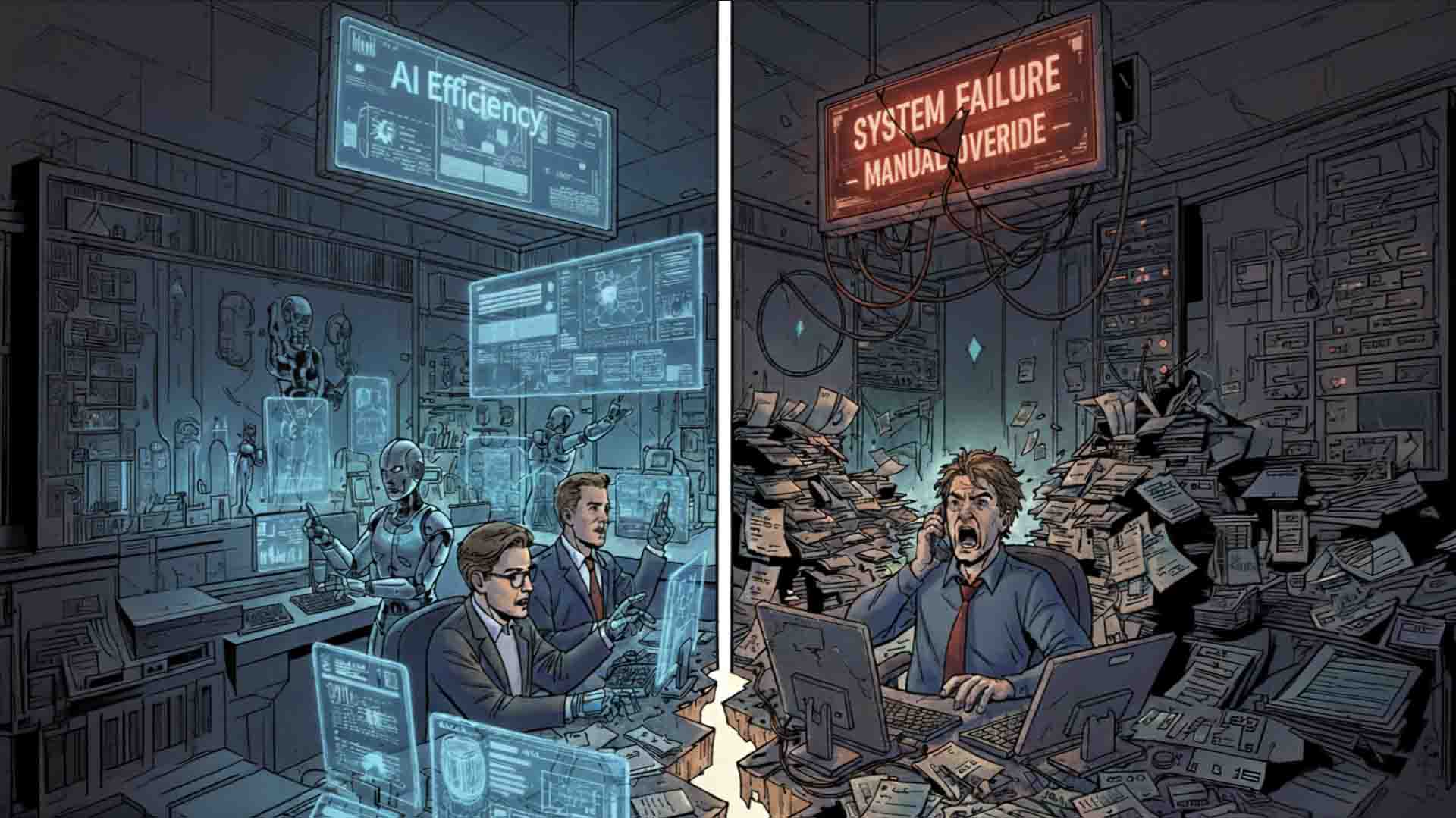
KI & Business· 5 minAI Efficiency in Banking: Opportunity, Fragility, and the Human FactorAI Efficiency in Banking has become the strategic answer to a core paradox: banks are knowledge-intensive service organisations whose human capital is also their greatest cost. Yet banks ultimately provide trust, not just transactions, and value comes from competence, continuity and judgement rather than speed alone. This article argues that every gain in scale carries a price that is not only financial but organisational and human, and asks what kind of efficiency banks can actually afford.Andreas Kamm·02.01.2026
KI & Business· 4 min4 Insights to Redesign Banking with AI & Employee FocusTo Redesign Banking effectively, transformation has to start on the inside. Internal user journeys, the daily experience of employees and operations teams, shape client outcomes just as much as the customer-facing interface does. This article lays out four insights, from the link between employee and customer satisfaction to the risk of digitizing broken processes, that show why empowering staff is the foundation for better banking.Andreas Kamm·15.04.2025