

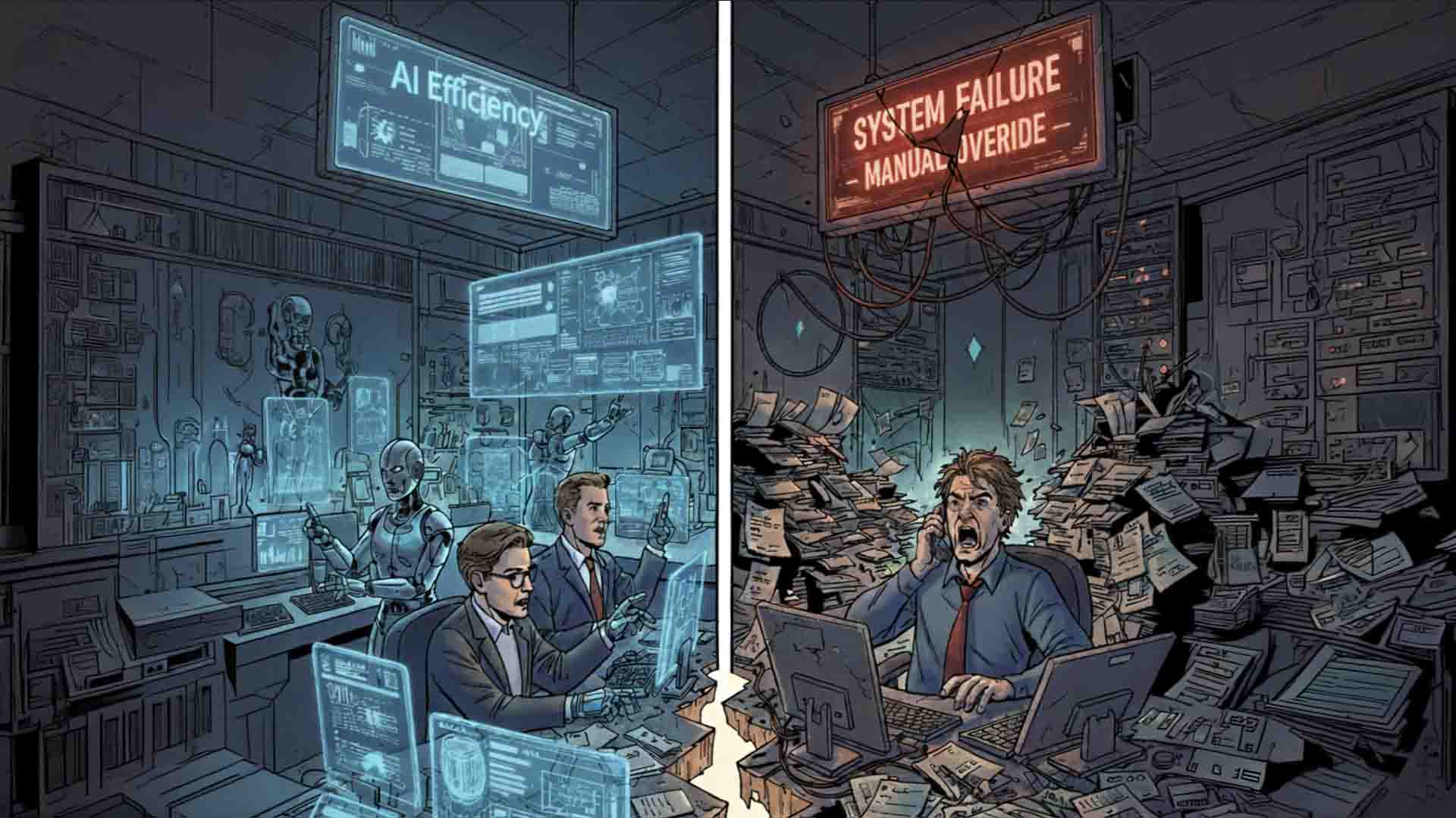
Banks are spending millions on AI and using it to polish processes they should be tearing down. If every AI use case must fit today's process, who is still allowed to imagine a different one? Banks are actively rethinking customer journeys, yet many AI initiatives still remain trapped inside the logic of the current process. The result is a pattern that looks innovative from the outside but leaves the underlying work largely untouched: AI polishes the old machine instead of helping redesign it.
This is a modern version of the innovator's dilemma:
- Stable processes,
- defined roles,
- established funding logic and
- a culture built around quality and control
have created strong institutions. Those same strengths now make it harder to imagine and fund AI driven ways of working that begin with uncertainty, experimentation and redesign rather than predictability and process adherence.
The Innovator's Dilemma Inside the Bank'
Clayton Christensen's innovator's dilemma explains why successful organisations often struggle to embrace disruptive change: the systems that make them strong in the present also make them cautious about uncertain future models. In banking, this dilemma does not only show up in products or strategy. It also appears inside day to day work across major journeys, wherever clients or employees move through structured steps, checks and approvals.
These journeys are designed for consistency. Steps are documented, responsibilities are fixed and quality is measured through control effectiveness, low error rates and audit readiness. Staff are hired and rewarded for executing defined processes reliably. In such an environment, innovation naturally gets channelled toward small improvements inside the process rather than bolder ideas that question whether some process elements should still exist.
A Scene from the Workshop
Picture a journey redesign workshop for client onboarding. The room is full of capable people from operations, compliance, business, IT and transformation. Someone asks a bold question: what if the bank stopped asking the client to complete a long form and instead built the journey around trusted internal data, external sources and only a few targeted client prompts.
For a moment, the idea opens up the room. Fewer handovers. Less repetition. A faster and more intelligent start to the client relationship. Then the old system quietly reasserts itself. Compliance asks how this will be evidenced. IT asks what systems would need to change. Finance asks how the benefit can be proven this year. Operations asks what happens to the current review steps. Within minutes, the team is back to a safer idea: use AI to help complete the existing form faster. That is the process cage in action. The bank is not rejecting innovation. It is narrowing it until it fits what already exists.
AI Process Transformation Stuck on Polishing
This is one of the clearest patterns in workplace AI adoption. Organisations often deploy AI first for lower risk and simpler tasks such as summarising text, drafting routine content and supporting administrative work. These applications are useful, but they usually optimise local tasks rather than change the overall structure of work.
That matters because time savings from small use cases are often quickly absorbed elsewhere. AI does not automatically reduce work and can even intensify it if organisations add new checks, outputs and expectations without redesigning the broader workflow. In other words, AI can make employees faster without actually making work lighter. In onboarding and review journeys, this shows up in familiar ways:
- AI drafts or reformulates client emails, but the communication chain stays the same.
- AI summarises files, but the number of reviews and meetings does not fall.
- AI pre fills fields in forms, but the form itself remains the operating model.
- AI supports analysts, but does not remove handovers, duplicate controls or low value approvals.
The visible effect is a smoother process. The deeper frustration is that very little meaningful time is freed for employees or clients.
Why People do not imagine further
A lack of technical expertise is not the main barrier. The deeper challenge is that many employees are not given the conditions to think playfully, experimentally and beyond the current workflow. Where that mindset is absent, people default to the safest and most obvious use cases.
Banking culture reinforces this pattern. Precision, accountability and risk awareness are essential strengths, but they also make experimentation feel uncomfortable. Employees are used to proving that a process works, not to playing with alternative ways of working. If AI is introduced into this environment without permission to explore, people will use it as a support tool for the current process rather than as a trigger for process reinvention.
Roles, Resources and Funding
Banks are full of highly capable people, but many have been hired into roles built around execution quality inside defined processes. KYC analysts, onboarding specialists, reviewers and relationship managers are trained to be precise, reliable and compliant. Their professional credibility often comes from handling complexity without deviation.
This shapes what feels legitimate to invent. A person whose value has long been measured by careful process execution may find it difficult to champion an idea that removes half the steps they currently perform. Even without explicit resistance, role identity can pull employees back toward incremental change.
The same logic appears in investment decisions. Banks typically fund initiatives through business cases that demand clear return on investment, measurable efficiency gains and well understood risk profiles. This approach makes sense for mature process improvements, but it is poorly suited to exploratory AI ideas whose value depends on learning, redesign and behaviour change.
As a result, safer use cases win funding. It is easier to approve an AI tool that accelerates document handling or improves completion of an existing form than to back a broader rethinking of the journey around data, events and adaptive decisioning. The first option fits the current operating model and can be measured in a spreadsheet. The second introduces uncertainty and threatens existing structures.
Why this matters in Swiss Banking
This tension is especially relevant in Swiss banking. Swiss institutions are rightly proud of stability, precision, discretion and trust. They also operate in an environment shaped by demanding regulatory expectations, complex client structures and strong audit discipline. These are not weaknesses. They are part of what gives Swiss banking its reputation.
But these same strengths can create a conservative default. In Swiss onboarding and periodic review journeys, it is easy to confuse process preservation with risk management. Forms, review calendars and approval layers may survive not because they remain the best way to manage risk, but because they are familiar, documented and defensible.
That is the uncomfortable question for Swiss banks:
Are the qualities that built trust now making it harder to explore AI in ways that could simplify journeys and free up expert capacity without weakening control?
What Leaders should do differently
A more ambitious AI strategy should start with a different objective. The aim should not only be to make current tasks faster, but to remove unnecessary work from the journey.
Three practical shifts would help:
- Choose one journey where AI must remove at least one step, not just speed up an existing one.
- Create a small funding track for learning projects where the return is insight and redesign potential, not only immediate savings.
- Give teams explicit permission and time to experiment with AI on real journey pain points inside controlled guardrails.
These steps do not weaken compliance. They help distinguish between genuine control needs and inherited process habits.
The real Risk
For leaders, the key question is no longer whether AI is being used. In many organisations, it already is. The better question is whether AI is only making today's work more elegant or whether it is helping create a simpler and more valuable operating model.
The real risk is not slow adoption. It is imaginative underuse: a future in which banks invest in many AI initiatives, yet still fail to free up meaningful time, simplify journeys or rethink work at its foundation.
If every AI use case must fit today's process, who in your organisation is actually responsible for imagining a different process?


Sources
- The Innovator’s Dilemma – Clayton M Christensen
- The Innovator’s Dilemma – Overview
- The Innovator’s Dilemma – PDF summary
- The Innovator’s Dilemma – Book listing
- The Innovator’s Dilemma – Summary notes
- AI in banking – Building the AI bank of the future
- AI in banking – Extracting value from AI in banking
- The future of banking – How AI is reshaping the industry
- AI and banking – AI/ML for small and midsize banks
- AI adoption – Most banks are playing it safe with AI
- AI at work – How AI can and cannot help lighten your load
- AI at work – 15 ways to use AI in the workforce
- AI in the workplace – Digital labour and future of work
- AI and work intensity – AI does not reduce work
- AI and creativity – Does generative AI enhance creativity?
- AI and creativity differences – Why AI boosts creativity for some
- AI imagination gap – Many AI efforts lack enough imagination
- AI experimentation – Why employees need time to experiment with AI
- Employee resistance to AI – Why your employees resist AI
- AI at work adoption – 85 percent of workers don’t use AI for business value
- Swiss banking and AI – Generative AI in banking overview
- Swiss banking innovation – Innovation: Leading in financial technology
- Swiss banking and regulation – Innovation and regulatory responsibility
- Swiss banking reputation – Why the Swiss banking sector is reliable and competitive