
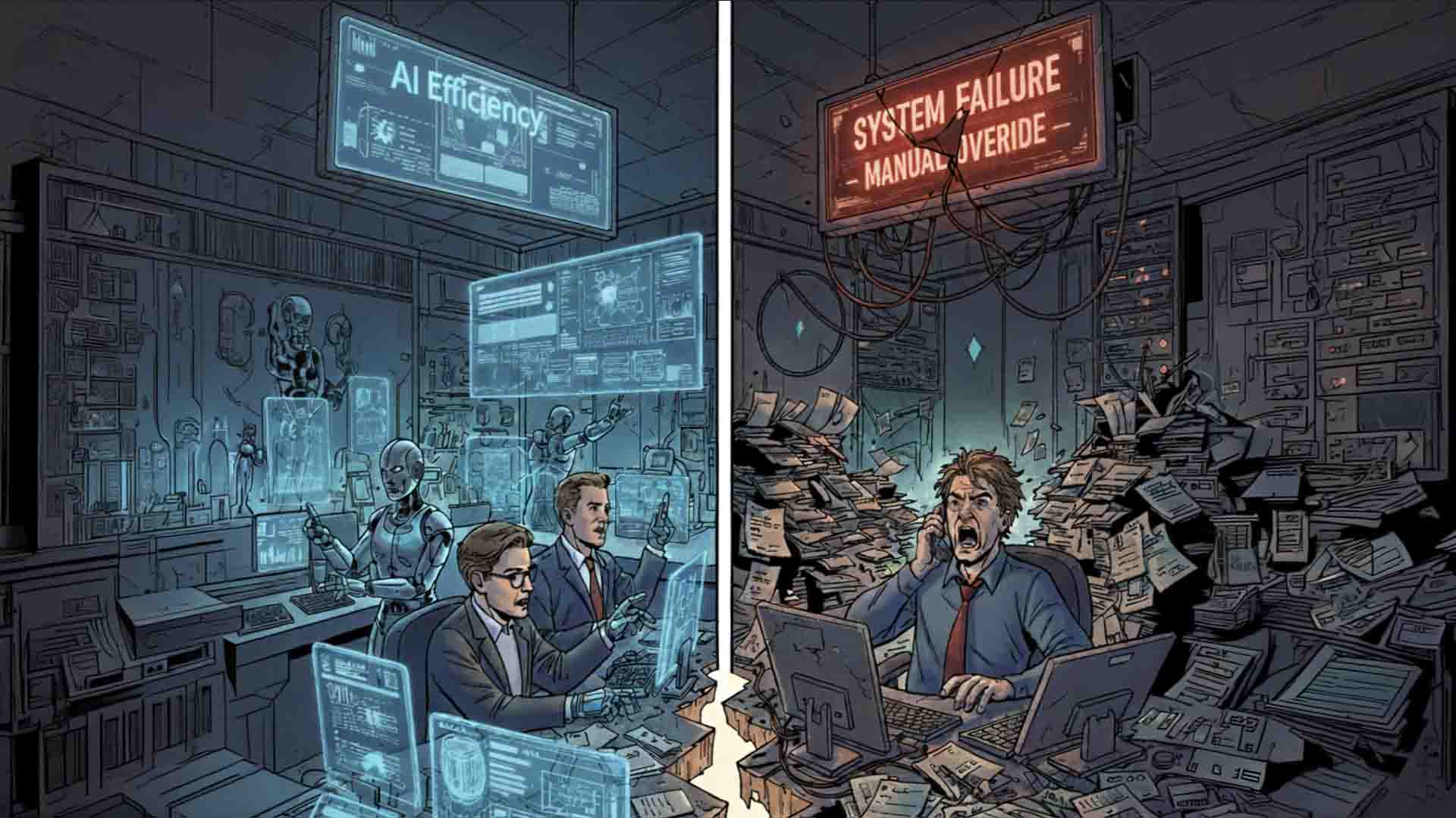
A high net worth client opening an additional bank account, a professional applying for a job, and an exporter waiting for trade documents all face the same structural problem: they are asked to prove the same facts again and again because trusted data is fragmented across institutions. In banking, employers and trade, the issue is often not lack of data but lack of reusable trust.123456
One problem, three worlds
For international HNWI clients, onboarding with an additional bank often still means repeated requests for identity documents, source of wealth explanations and supporting evidence, even when another institution has already performed a detailed review. In hiring, employers increasingly receive digital applications through portals, but candidates still repeatedly upload diplomas, IDs and reference material because verification remains fragmented. In trade finance, paper bills of lading historically delayed cargo release and financing because the original document had to move physically between parties.2346781
The common pattern is simple: every institution wants its own version of the file. That creates a weaker experience and expands the volume of duplicate personal data stored across banks, HR systems and intermediaries instead of moving toward one trusted, reusable source of truth.48910111
Portable Trust: The Building Blocks Already Exist
Outside banking, the idea of reusable proof is already becoming real. Verifiable credentials are designed to let organisations issue digital proofs, such as
- diplomas,
- licences or
- employment records,
that are cryptographically secure, privacy respecting and machine verifiable. Education and employment are two of the most active use cases, with initiatives focused on digital diplomas, learning and employment records, and career wallets that let people present verified information directly to employers.5712132
Banking already has a parallel infrastructure, but it sits inside the institution. Moody’s describes its KYC offering as an end to end solution spanning entity data, individual data, risk intelligence, onboarding and ongoing monitoring, including support for digital onboarding and perpetual KYC. That is powerful, but it is still institution centric: it helps banks know clients better, not clients carry trusted data from one institution to another.141514
Singapore shows the Cross Sector Model
Singapore’s Singpass shows what happens when digital identity grows into a broader trust rail. Singpass is the country’s national digital identity and is used across more than 2,000 public and private services. The critical layer is MyInfo, which lets users consent to the reuse of official personal data from government sources when dealing with banks, government agencies and other service providers, reducing form filling and repeated document submission.1617181920
This matters because it turns trusted data into reusable infrastructure. Instead of uploading the same proof of identity or address again and again, a person can permit a service provider to retrieve authenticated data directly from authoritative sources. In other words, Singapore already operates a practical version of the portable trust model that many other countries are only beginning to imagine.171920
Switzerland is building similar Rails
Switzerland is also laying important foundations. SwissID is a secure login and digital identity service used for online services that require proof of identity, while users can manage approvals and trust levels for data sharing. At the state level, the Swiss e-ID is designed as an official digital proof of identity, stored in a wallet and intended for use with public authorities and private services, with selective disclosure and data minimisation built into the concept.10112122
The electronic patient record (EPR) adds an important second lesson. Switzerland’s EPR is a personal collection of health related documents that patients can share with authorised healthcare professionals through secure digital access. The patient controls access rights, and the whole concept is designed to reduce fragmentation by replacing many partial records and document exchanges with one consent managed view of treatment relevant data.232425262728
Together, these two examples matter for the broader argument. Swiss e-ID shows how trusted identity and selective disclosure can work at the national level, while the electronic patient record shows that Switzerland is already willing to apply a single shared record with user controlled access in a highly sensitive sector. Banking and employment have not yet caught up, but the conceptual move is already happening.2225281023
What Trade already proved
Trade offers the clearest analogy. The bill of lading is one of the most sensitive documents in global commerce because it proves control over goods and underpins financing and release. Electronic bills of lading, including blockchain based models, show that high value multi party documentation can move from paper to shared digital originals with stronger auditability, lower fraud risk and faster processing.3629
That matters far beyond shipping. If markets can trust a digital trade document to trigger movement of goods and money across borders, then banks and employers should also be able to trust digital proofs of identity, education, employment and selected wealth facts.11133
The next Step: A personal Trust Wallet
The broader opportunity is a personal trust wallet, or what could be called a life file. It would not replace banks, universities, employers or governments as issuers of truth. Instead, it would let a person hold verified credentials from those issuers in one place and share only the relevant pieces depending on the moment: a diploma for a job application, a residence credential for a municipal service, or identity and source of wealth credentials for a bank.132522
For HNWI clients, this could be particularly valuable. A client with an international footprint could share verified identity attributes, address data, parts of a beneficial ownership structure and a curated source of wealth narrative as reusable credentials, while the receiving bank adds only the checks specific to its own risk appetite. The gain is not that due diligence disappears. The gain is that the client does not have to restart from zero every time.151414
Benefits, Risks and Fixes
The benefits are simple:
- less repetition for clients,
- less document chasing for banks and employers, and
- fewer copies of the same personal data spread across multiple systems.
The main risks are concentration, governance and reliance: too much dependence on one provider, unclear control over access and responsibility, and uncertainty about when institutions can trust someone else’s verified data.912301022
The fixes are equally practical. Use open standards for verifiable credentials so no single provider owns the ecosystem. Anchor core identity in trusted frameworks such as state backed e-ID systems, while allowing banks, employers, universities and public institutions to issue additional credentials on top. Keep sharing granular and revocable, so people remain in control of who sees what and for how long. Then test the model through narrow pilots before trying to redesign every journey at once.612252631410111322
Why Switzerland could matter
Switzerland has unusually strong ingredients for this shift: trusted institutions, high privacy expectations, a growing digital identity stack and now a live example in healthcare of how sensitive records can be shared under user control. That creates an opportunity to move beyond digital login and toward premium portable trust: a model where residents, professionals and international clients can reuse verified data safely across banks, employers and public services.212528101123
Singapore offers a useful benchmark. It shows how a state backed identity plus consent based data reuse can become everyday infrastructure across sectors. Switzerland does not need to copy that model, but it can learn from it while building on its own strengths in privacy, trust and regulated service industries.19201122
A better Ambition
The point is not to create one more digital filing cabinet. The point is to reduce repetitive verification, shrink the number of duplicate files held about the same person and free up time for the conversations that actually matter: advice, hiring judgement, service and trust.3212910
If other sectors and countries are already learning how to reuse trusted data with consent, why are banks and employers still asking people to rebuild trust from scratch every time?251923

Sources
- CORE: Moody's Commitment to Risk and Transparency
- Verifiable Credentials for Education, Employment, and ...
- Blockchain E-Bill of Lading: Unlocking Potential & Security - WNS
- Client onboarding best practices for financial institutions
- On Wallets - General - Velocity
- Tech Insight : Blockchain Bil - Surf Tech IT
- [PDF] Credentials to Employment: The Last Mile
- Coming soon — a resume-validating blockchain network for job ...
- How to Build Client Trust with Transparent Wealth Data Management?
- FAQ: security and data protection
- The e-ID works like a digital ID card
- Verifiable Credentials Explained
- 4.2 Embedded Proofs
- Moody's Analytics on the power of the LEI in KYC and ...
- Moody's KYC Solutions for Efficient Customer Onboarding ...
- Singpass | Government Technology Agency of Singapore ...
- Singapore's National Digital Identity - Singpass
- Factsheet – Singpass (Singapore's National Digital Identity)
- Digital identity | Government Technology Agency of Singapore ...
- How Singapore's national digital identity and government digital ...
- SwissID: Home
- The Electronic Identity (e-ID)
- The EPR - The Electronic Patient Record
- Electronic patient record
- The EPR in a nutshell
- Electronic Patient Dossier (EPD)
- Electronic Patient Record (EPR) – USZ
- The electronic patient record is to become a central pillar of the healthcare system
- METEOR STIP MARUNDA
- The Credit Rating Controversy | Council on Foreign Relations
- How to verify a credential - EBSI hub
- Home